Launching Hardware in the US: The Regulatory Map Nobody Hands You
US product compliance isn't one approval. It's a stack of agencies, carriers, states and buyers, each with its own test, and no single office hands you the whole list. If your product has a radio and a lithium battery, as most robots, drones, e-bikes and smart devices do, you'll meet nearly all of them.
US product compliance isn’t one approval. It’s a stack of agencies, carriers, states and buyers, each with its own test, and no single office hands you the whole list. If your product has a radio and a lithium battery, as most robots, drones, e-bikes and smart devices do, you’ll meet nearly all of them.
This guide follows the questions a launch actually raises, not the org chart. It’s current as of October 2026, a year in which several of these rules changed. It isn’t legal advice: where a rule is pending or unclear, we say so.
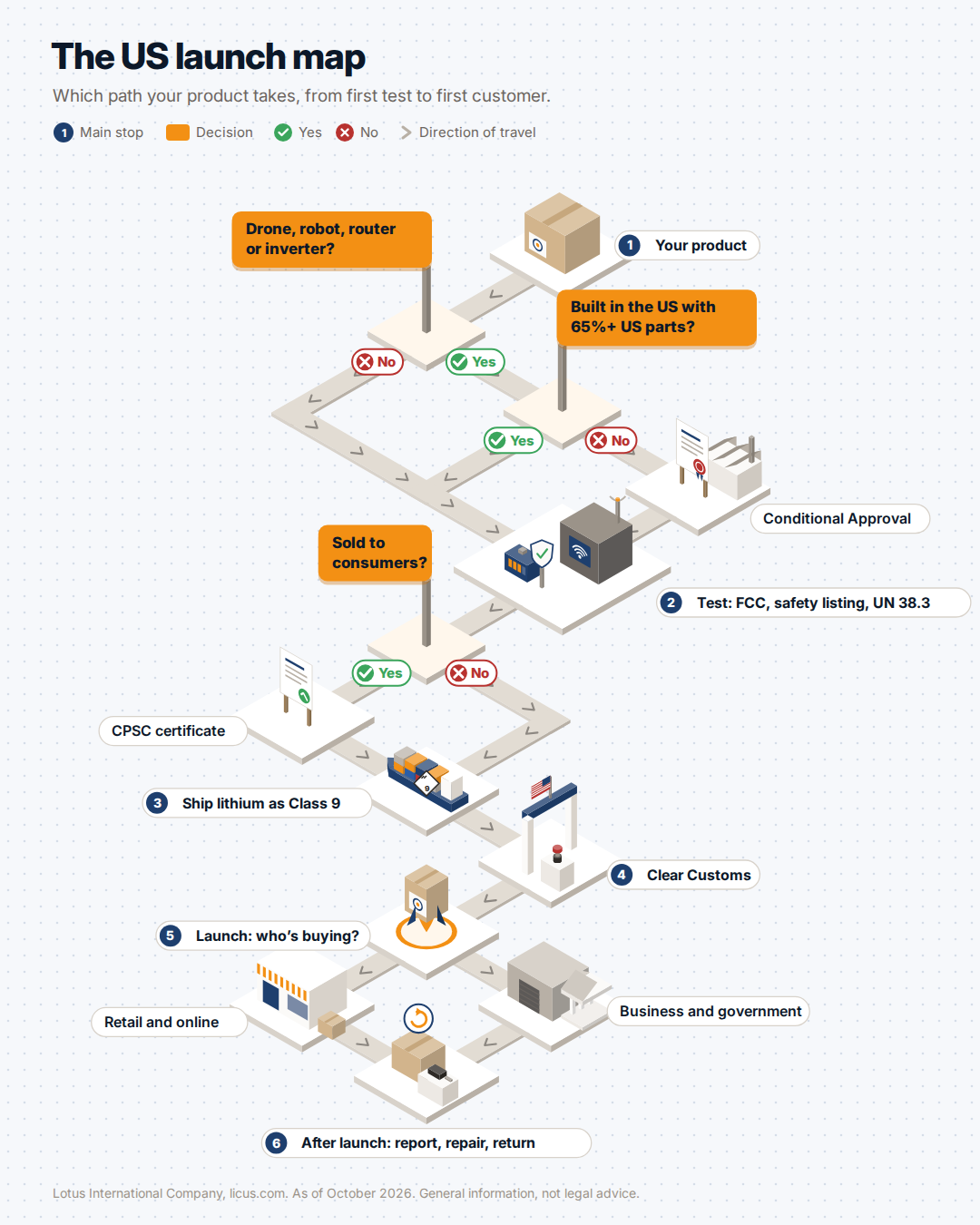
In short
- Can it be sold? Anything that emits radio needs FCC authorization. Since December 2025, whole product categories made outside the US (drones, consumer routers, mobile robots, grid-tied inverters) can’t get new approvals without an exemption. Consumer products also answer to the CPSC, and workplaces and most retailers expect a safety listing such as UL or ETL.
- Can it be shipped? Lithium batteries need UN 38.3 testing, the right dangerous-goods class and, since January 2026, a lower state of charge for some air freight.
- Can it clear Customs? Every import needs an origin marking and an importer of record. Regulated consumer products now need certificate data filed at entry.
- What can you claim? An unqualified “Made in USA” claim means all or virtually all US-made. The US uses four different “made in” tests.
- Who’s buying? Retailers, insurers, enterprises and government buyers each add their own requirements.
- Which states? Battery fees, e-bike battery laws and right-to-repair laws vary by state.
- After launch? Safety reporting within 24 hours, change control on your FCC grant, warranty rules and repair parts.
1. Can it legally be sold?
The FCC radio approval
Almost any electronic product that gives off radio energy needs FCC equipment authorization before it can be imported, marketed or sold. There are two routes.
- Supplier’s Declaration of Conformity (SDoC) covers devices with digital circuits but no transmitter, such as a charger or a robot base with no radio. You test, then declare. The responsible party must be located in the US.
- Certification covers anything with Wi-Fi, Bluetooth, cellular, LoRa or a drone control link. A Telecommunication Certification Body (TCB) reviews your test reports and issues the grant.
Certification runs in six steps:
- Register for an FCC Registration Number (FRN).
- Get a grantee code. It becomes the permanent prefix of every FCC ID you hold.
- Test at an FCC-recognized accredited lab.
- File with a TCB. The filing includes an attestation that the product isn’t on the Covered List and, for a foreign applicant, a US agent who can accept legal papers.
- The TCB issues the grant in the FCC’s public database.
- Label the product with its FCC ID. A pre-certified radio module carries “Contains FCC ID” on the host, which still needs its own testing.
Two changes landed this year. Since October 13, 2026, the FCC won’t authorize new devices that contain chips or other logic-bearing parts made by companies on its Covered List, such as Huawei, ZTE, Hikvision and Dahua. And online marketplaces must show FCC IDs on listings: from March 1, 2027 for platforms that sell directly, and June 1, 2027 for third-party listings.
The Covered List: where it’s made now decides
Until late 2025, the Covered List named companies. It now also names whole product categories by where they’re produced, whoever owns the factory. Covered products can’t get new FCC authorizations. Models authorized before the listing date can generally still be sold, but changes to them are restricted.
| Category | Listed | Ways through |
|---|---|---|
| Drones and critical drone parts (flight controllers, radios, ground stations, navigation, cameras and sensors, batteries, motors) | Dec 22, 2025 | Blue UAS Cleared List or Buy American “domestic end product” (both exempt until Jan 1, 2028); a Conditional Approval; toy drones of 150 g or less have been excluded since June 2026 |
| Consumer routers | Mar 23, 2026 | A Conditional Approval |
| Advanced robotic devices | July 28, 2026 | A Conditional Approval from the Department of War; domestic end products aren’t “foreign-produced” |
| Grid-tied inverters | July 28, 2026 (narrowed Aug 20) | A Conditional Approval; domestic end products aren’t covered |
The robot listing is narrower than the name suggests. A robot is covered only if it moves on its own, operates at a distance from its operator, weighs more than 4.4 lb with its dock, and has all three of these: a sensor that perceives its surroundings, a network connection of at least 200 kbps, and software for autonomous navigation, perception or remote control. The FCC says robot vacuums and robot mowers are covered if they meet that test. Fixed robot arms, vehicles and FDA-regulated medical devices are not.
What counts as US-made depends on the category. For robots and inverters, “foreign-produced” means anything that isn’t a Buy American domestic end product: manufactured in the US, with US components above 65% of component cost today, a threshold that rises in 2029. For drones, the FCC says the producer’s nationality doesn’t matter, and a US-made drone with foreign parts isn’t covered if it meets the Blue UAS or Buy American standard. Beyond that, it hasn’t defined “produced.”
A Conditional Approval application covers your ownership, your supply chain and a US manufacturing and onshoring plan. For drones and robots, an approval stays in force as long as you keep to that plan. The FCC has published a steady run of approvals since September.
None of this depends on which country you build in. A product built in Taiwan, Korea or Germany is “foreign-produced” in the same way as one built in China.
Your test lab
Since 2025, the FCC has withdrawn recognition from test labs owned or controlled by foreign adversaries. On October 29, 2026, it votes on a broader step: ending recognition of every lab in mainland China on December 1, 2028. Labs in China tested 82% of the devices that applied for FCC authorization in 2025. Grants already issued would stay valid.
If your next product will be tested after 2028, the lab you pick now matters.
CPSC: consumer product safety
The Consumer Product Safety Commission (CPSC) can act against any consumer product with a defect that creates a substantial hazard. Products under a specific CPSC rule, such as anything with button or coin cells, children’s products and bicycles including e-bikes, also need a certificate based on testing.
Since July 8, 2026, importers have had to file that certificate data electronically when goods enter the US.
A federal battery rule for e-bikes and e-scooters is on the way but not final. Proposed in June 2026, it would make the UL 2849, UL 2271 and UL 2272 standards mandatory, including for replacement packs and conversion kits. Comments closed in August. A final rule would apply to products made 180 days after it’s published.
Safety listing: UL, ETL, CSA
For most products, no federal law says “get a UL listing.” In practice, you’ll need one. OSHA requires employers to use electrical equipment that a Nationally Recognized Testing Laboratory (NRTL) has listed or approved, so warehouses, hospitals and factories won’t deploy an unlisted robot or charger. Most retailers and insurers ask for listings too.
The standards buyers name most often are:
- Industrial robots: ANSI/A3 R15.06; R15.08 for industrial mobile robots.
- AGVs and AMRs: UL 3100.
- Service and consumer robots: UL 3300.
- Commercial drones: UL 3030 for the electrical system.
- E-mobility: UL 2849 (e-bikes), UL 2272 (e-scooters) and UL 2271 (battery packs).
For e-mobility, the listing is already law in places. New York City requires it for e-bikes, e-scooters and their batteries, New York State for the batteries, and California since January 1, 2026.
Category add-ons
- Drones: FAA Remote ID. You build to an FAA-accepted standard and file a declaration of compliance with the FAA before selling. It’s a separate agency and a separate approval from the FCC. The FAA’s beyond-line-of-sight rule (Part 108) is still pending.
- Chargers and power supplies: DOE efficiency standards. External power supplies must meet Level VI, and battery chargers must be certified in DOE’s database.
2. Can it be shipped?
Lithium batteries are Class 9 dangerous goods. Before any of your batteries move by air, sea or truck, the cell or battery design must pass UN 38.3 testing, and you need the test summary on hand. Carriers, freight forwarders and retailers will ask for it.
The shipping class depends on how the battery travels:
| How it ships | UN number |
|---|---|
| Batteries on their own (spares, replacement packs) | UN 3480 |
| Packed in the same box as the product, but not installed | UN 3481 (packed with equipment) |
| Installed in the product | UN 3481 (contained in equipment) |
One rule changed on January 1, 2026. By air, lithium-ion batteries packed with equipment (above 2.7 Wh) must ship at no more than 30% state of charge. For batteries installed in the product, the lower charge is still only a recommendation. Watch the boundary: a robot vacuum whose battery is boxed separately counts as “packed with,” not “contained in.”
The rules don’t end at the port. Once the goods land, anyone who repacks or reships them in the US follows US Department of Transportation hazmat rules, which require trained staff and a copy of your UN 38.3 summary.
3. Can it get through Customs?
Every import must be marked in English with its country of origin, for example “Made in Taiwan.” US Customs and Border Protection (CBP) decides origin by where the product last went through a “substantial transformation,” meaning it became a new article with a new name, character or use. Simple assembly usually doesn’t qualify. CBP decides case by case and will issue a binding ruling if you ask for one.
Origin matters twice: it sets the duty you pay, and it’s the first thing a reviewer checks against any “made in” claim you make later.
The importer of record carries the legal responsibility at the border:
- classification and value
- origin and marking
- duties
- CPSC certificate data for regulated products
- confirming every radio device is FCC-authorized
Foreign companies can act as their own importer of record, usually with a US customs bond and a licensed customs broker.
Tariffs moved a lot this year, so we won’t quote rates; they change faster than a blog post. The broad shape as of October 2026:
- The Supreme Court struck down tariffs imposed under emergency powers (IEEPA) in February.
- Country-based tariffs now run under Section 301.
- Drones and their critical parts have carried their own Section 232 tariff since September 3.
- A Section 232 investigation into robotics and industrial machinery is still open.
Check rates with a licensed broker when you plan each shipment.
4. What can you claim?
An unqualified “Made in USA” claim, on a label, a website, a brochure or a trade-show banner, means the product is “all or virtually all” made in the US. Final assembly and all significant processing must happen here, and foreign content must be negligible. Assembling imported parts in the US doesn’t meet that bar on its own. If your product doesn’t, qualified claims such as “Assembled in USA” or “Made in USA with imported parts” are allowed when they’re accurate and clear.
The Federal Trade Commission (FTC) is enforcing this actively:
- March 2026: an executive order told the FTC to prioritize Made in USA enforcement.
- April 2026: the FTC announced three cases. One maker of electronic dartboards, assembled in the US with imported chips, cameras and monitors, paid $625,000 in consumer redress.
- July 2026: warning letters went to seven companies, including several that sell business to business.
Penalties run up to $53,088 per violation.
Four tests, four answers
The US uses four different “made in” tests, and one product can pass some and fail others. Take a robot designed abroad and finished in the US:
| Test | Who uses it | The bar | Robot designed abroad, finished in the US |
|---|---|---|---|
| Country of origin | CBP, for marking and duties | Where it was last “substantially transformed” | US origin only if the US work turns the parts into a new article |
| “Made in USA” claim | FTC, for labels and advertising | All or virtually all US-made | Almost certainly not unqualified; “Assembled in USA” may fit |
| Domestic end product | Federal buyers (Buy American), and the FCC for robots and inverters | Manufactured in the US, with US components above 65% of cost (rising in 2029) | Passes only if the US component share clears the bar |
| “Produced in a foreign country” | FCC Covered List | Robots and inverters: not a domestic end product. Drones: not defined beyond Blue UAS or Buy American | Same answer as the row above |
The practical lesson: decide which test you need to pass before you choose suppliers, not after. Try it with your own product:
One product, four “made in” answers
Change where your product is built and what it’s built from. The carton label and the four tests below update as you go.
Try it: move final assembly to the US, add US sub-assembly work, then drag past 65%.
Simplified. Real decisions are case by case.
An illustration of how the tests differ, not legal advice. The home robot is assumed to be a mobile robot over 4.4 lb with sensors, Wi-Fi and autonomy software. Thresholds are as of October 2026; the Buy American bar rises in 2029.
5. Who's buying?
Much of what you'll actually be asked for comes from buyers, not regulators.
- Retailers and marketplaces commonly ask for a UN 38.3 summary and a Safety Data Sheet for anything with a lithium battery, a safety listing for chargers and mains-powered products, and the e-mobility UL standards for e-bikes and e-scooters. From 2027, FCC rules require marketplaces to show FCC IDs, so expect platforms to check yours. Each retailer's vendor portal has the exact list.
- Enterprise buyers and their insurers typically want an NRTL listing, product liability insurance that names them as an additional insured, and a US entity they can hold responsible.
- Federal buyers add their own rules on top:
- Buy American: the domestic-end-product test.
- Trade Agreements Act: on larger contracts, products must come from the US or a "designated" country. Taiwan and Korea qualify; China and Vietnam don't.
- Section 889 of the 2019 defense bill: bars equipment from Huawei, ZTE, Hytera, Hikvision and Dahua.
- Drones: federal drone rules bar drones from Chinese and other covered foreign entities. The Blue UAS list, run by the Defense Contract Management Agency, is the usual way in. Several states apply similar limits to their own agencies.
6. State-level surprises
Federal approval doesn't cover the states. Four kinds of state rule catch launch teams most often.
California Proposition 65. Products sold in California need a warning when they can expose users to listed chemicals, such as lead in cables and solder or certain plasticizers. Private enforcers bring most cases.
Battery fees and take-back programs. Since January 1, 2026, California retailers have collected a recycling fee on products with batteries that can't easily be removed: 1.5% of the price, capped at $15. Manufacturers owe expanded reporting from July 1, 2027. Products with removable batteries fall under a separate stewardship law, with programs due by April 1, 2027. Other states are phasing in their own battery laws, so check each state you sell in.
E-bike and e-scooter batteries. New York City, New York State and California require certified batteries and products, as covered in section 1. Expect other cities to follow.
Right to repair. Several states now require manufacturers to make repair documentation, parts and tools available. Whether a robot or drone is covered depends on each law's exclusions.
| State | In force since | What you must provide | Exclusions that matter here |
|---|---|---|---|
| California | July 1, 2024 | Documentation, parts and tools: 3 years after last manufacture for products from $50 to $99.99 wholesale, 7 years at $100 and up | Outdoor power, lawn and garden, and industrial equipment |
| Minnesota | July 1, 2024 | Documentation, parts, tools and software, on fair terms; limits on parts pairing | Lawn and garden, outdoor power, industrial and energy storage equipment |
| New York | Dec 28, 2023 | Documentation, parts and tools; documentation and tools free | Products sold only to businesses or government; home appliances |
| Colorado | Jan 1, 2026 | Documentation, software, tools and parts; parts pairing banned | Industrial equipment, power tools, energy storage, aviation |
| Oregon | Jan 1, 2025 | The same access as your authorized repair shops; parts pairing banned | Consumer electronics only |
In plain terms: a home robot sold to consumers is likely covered in several states. A robot mower may fall under the lawn-and-garden exclusions. Read each statute against your product.
7. After launch
Your obligations don't end at first shipment. Four of them run for the life of the product.
Safety reporting. Under Section 15(b) of the Consumer Product Safety Act, manufacturers, importers, distributors and retailers must tell the CPSC within 24 hours once they have information that reasonably supports a reportable hazard. Late reporting is where the largest penalties come from. If a company won't cooperate on a recall, the CPSC can warn the public directly. It did so in March 2026, when a Chinese e-bike maker refused an acceptable recall after 11 fire reports.
Changes to an approved product. Minor changes can usually be made under your existing FCC grant. Changes that affect radio performance or emissions may need a new filing or a new FCC ID. In Covered List categories, changes to pre-listing models are restricted. For robots and inverters, a blanket waiver allows certain software and firmware updates through at least January 1, 2029. Hardware changes need their own waiver.
Warranties. If you offer a written warranty on a consumer product, the Magnuson-Moss Warranty Act sets the rules. Its terms must be available before the sale, and warranties above $10 must be labeled "full" or "limited."
Repair and returns. Right-to-repair laws (section 6) mean parts, tools and documentation must stay available for years after launch. Returned units need somewhere to go in the US. Shipping each one back overseas means freight, duty and dangerous-goods paperwork on every unit, so many brands set up a US repair path before launch.
Who owns what in US product compliance
Each item has a usual owner. It helps to name them before launch.
| Requirement | Usually owned by |
|---|---|
| FCC authorization | The brand, as grantee, with a test lab and a TCB |
| US agent or SDoC responsible party | A US entity the brand names |
| Covered List route (exemption or Conditional Approval) | The brand |
| Safety listing (UL, ETL, CSA) | The brand holds it; the NRTL tests the product and audits the production site |
| UN 38.3 test summary | The battery maker, passed down by the brand |
| Hazmat shipping inside the US | Whoever ships: the 3PL or distributor |
| Origin marking, duties, CPSC eFiling | The importer of record |
| "Made in USA" and other origin claims | The brand |
| Prop 65, battery fees, right to repair | The brand; retailers collect California's battery fee |
| Safety reporting under 15(b) | Everyone in the chain |
| Returns and repair | The brand, or a depot repair partner |
Build the list for your own launch:
Your launch checklist
Answer four questions. You’ll get the requirements that apply to your launch, sorted by the sections of this guide, with who usually owns each.
A starting list, not legal advice. It reflects rules as of October 2026 and assumes the product has a radio and a lithium-ion battery. Confirm with counsel, your test lab and a licensed customs broker.
Where a US partner fits
Lotus International Company is a US-based contract manufacturer in Canton, Michigan. Your approvals stay yours: we don't hold your FCC grant or your listing, and your compliance decisions stay with your team. What we do is give several of the items above a US address.
- Final assembly, box build and functional test in Canton, with the country-of-origin and substantial-transformation documentation a Customs, Buy American or FCC review asks for.
- Lithium products handled as Class 9 against your UN 38.3 summary, through storage, kitting and shipping.
- Documentation support for your UL or ETL listing. You hold the listing.
- Customs clearance through our licensed customs broker partner. In most programs, you stay the importer of record.
- Depot repair and returns in the US, whether we built the product or not, with failure data back to your engineering team.
Planning a US launch for a connected or battery-powered product?
Frequently asked questions
Does my product need FCC certification?
If it has any radio, such as Wi-Fi, Bluetooth, cellular or a drone control link, it needs Certification through a TCB. Products with digital circuits but no transmitter usually take the simpler SDoC route.
Can a product made in Taiwan or Korea still get FCC approval?
In most categories, yes, through the normal process. Drones, consumer routers, advanced mobile robots and grid-tied inverters are the exception: if they're made outside the US, they need an exemption or a Conditional Approval, whichever country they come from.
Are robot vacuums and robot mowers on the FCC Covered List?
The FCC says they're covered if they meet its definition: over 4.4 lb with the dock, with a sensor, a connection of at least 200 kbps and autonomy software. Models authorized before July 28, 2026 can generally still be sold.
Is UL certification required in the US?
For most products it isn't federal law. But OSHA effectively requires listed equipment in workplaces, most retailers and insurers ask for it, and New York City, New York State and California require it for e-bikes, e-scooters and their batteries.
Can I say "Made in USA" if the product is assembled here?
Not without qualification, unless all or virtually all of it is US-made. "Assembled in USA" or "Made in USA with imported parts" may be accurate instead.
What's the difference between UN 3480 and UN 3481?
UN 3480 is lithium-ion batteries shipped on their own. UN 3481 is batteries packed with or installed in equipment. Since January 2026, air shipments of batteries packed with equipment must be at 30% charge or less.
Who is the importer of record?
The party legally responsible for an import's classification, value, origin, duties and filings. A foreign brand can take that role, usually with a US customs bond and a licensed broker.
This guide is general information, current as of October 2026, and isn't legal advice. Rules in this area change often; confirm current requirements with qualified counsel, your test lab and a licensed customs broker.
Sources
- FCC, Covered List and Covered List FAQs: UAS and UAS critical components
- FCC, DA 26-761: UAS exemption extension to Jan 1, 2028 and DA 26-1063: Conditional Approvals, Oct 2, 2026
- K&L Gates, FCC adds foreign-produced advanced robotic devices to the Covered List
- Wiley, Foreign-produced power inverters and advanced robotic devices
- Hogan Lovells, FCC closes component loophole; online marketplaces
- DroneXL, FCC vote on mainland China test labs
- CPSC, Mandatory eFiling for certificates of compliance
- Federal Register, Proposed micromobility lithium-ion battery standard
- TechTimes, Second CPSC warning on Ridstar e-bikes
- NYC, Local Law 39 of 2023
- UL Solutions, Drone and UAV certification (UL 3030)
- IATA, Lithium Battery Guidance Document 2026
- Thomson Reuters, US tariff authorities after IEEPA
- FTC, Warning letters on Made in USA claims, July 2026; Arnold & Porter, April 2026 enforcement sweep
- Acquisition.gov, FAR Subpart 25.1, Buy American
- Sales Tax Institute, California battery recycling fee (SB 1215)
- California DCA, SB 244 industry advisory; Minnesota, Statute 325E.72; Colorado, HB24-1121