The FCC Redrew the Map for Robots and Inverters in America: Here’s How to Stay on It
Models authorized by the FCC before July 28, 2026 are not barred by this new listing. Your next model may not clear the gate.
Models authorized by the FCC before July 28, 2026 are not barred by this new listing. Your next model may not clear the gate.
On that date, the FCC added foreign-produced advanced robotic devices and foreign-produced power inverters to its Covered List. Covered equipment generally cannot receive a new FCC equipment authorization — and for commercial products that need one, that means no lawful import, marketing, or sale of new models in the US. (Equipment sold exclusively to the US government or its agencies is treated differently.)
The robotics category can reach warehouse AMRs, robotic mowers, delivery robots, quadrupeds, and humanoid platforms when a product meets the definition: a ground-mobile machine over 4.4 pounds counting any dock, operating at a distance from a human operator, with a sensor, connectivity of at least 200 kbps in either direction, and controlling software — including AI or machine-learning model weights. Connected vehicles, drones, certain medical devices, and fixed industrial robots are excluded, but the test is functional, not industry-specific.
The inverter entry covers devices converting DC to AC or AC to DC — micro, string, central, hybrid — that also contain remote communication, control, or monitoring components. It never mentions the electrical grid. Read both definitions against your product; do not assume.
If you manufacture outside the United States and sell into the American market, this new market-access barrier is now yours to solve.
The test is where you build — not who you are
The rule asks one question: does the product qualify as a domestic end product under the Buy American Act (48 CFR § 25.101(a))? Two parts:
- The article is manufactured in the United States, and
- The cost of its domestic components exceeds 65% of the cost of all its components (rising to 75% for items delivered starting in 2029)
Fail either part and the product is foreign-produced. Nationality, ownership, and track record do not matter. Three details make the test stricter than it looks:
- Allied content counts as foreign. No credit for treaty partners. A German motor is foreign. A Japanese sensor is foreign.
- No off-the-shelf exception. The FCC does not apply the usual COTS waiver here.
- Undocumented origin works against you. A part you cannot adequately document cannot safely be claimed as domestic.
The math is hard. But passing both prongs generally provides the most direct route for a new commercial model: the product is not covered by this foreign-production listing, subject to any separate Covered List restriction — like the component rule below. No discretionary approval to wait on, none to lose.
One design note: the FCC has not yet explained how the 2029 step-up to 75% applies to previously authorized models. Do not engineer a product to barely clear 65%. Build in headroom.
What is grandfathered — and the trap inside it
Models authorized before July 28, 2026 are not barred from continued import or sale by this listing itself, and an FCC waiver allows certain software and firmware updates through at least January 1, 2029.
Hardware is a different story. A hardware change requiring a new authorization runs the modified product into the Covered List. Whether a specific radio, sensor, or antenna change requires one is fact-dependent — treat authorized configurations as potentially frozen until your certification counsel or test lab says otherwise.
And a product in development, or even in inventory, on July 28 but not yet authorized has no protection. Only the authorization counts. The real exposure is not this year’s revenue. It is your roadmap.
The real exposure is not this year’s revenue. It is your roadmap.
Eight years, one direction
Waiting for this to soften is a plan the history argues against. July’s action was the third category-wide, origin-based expansion since December 2025 — inside a program running continuously since 2018, across three administrations and both parties:
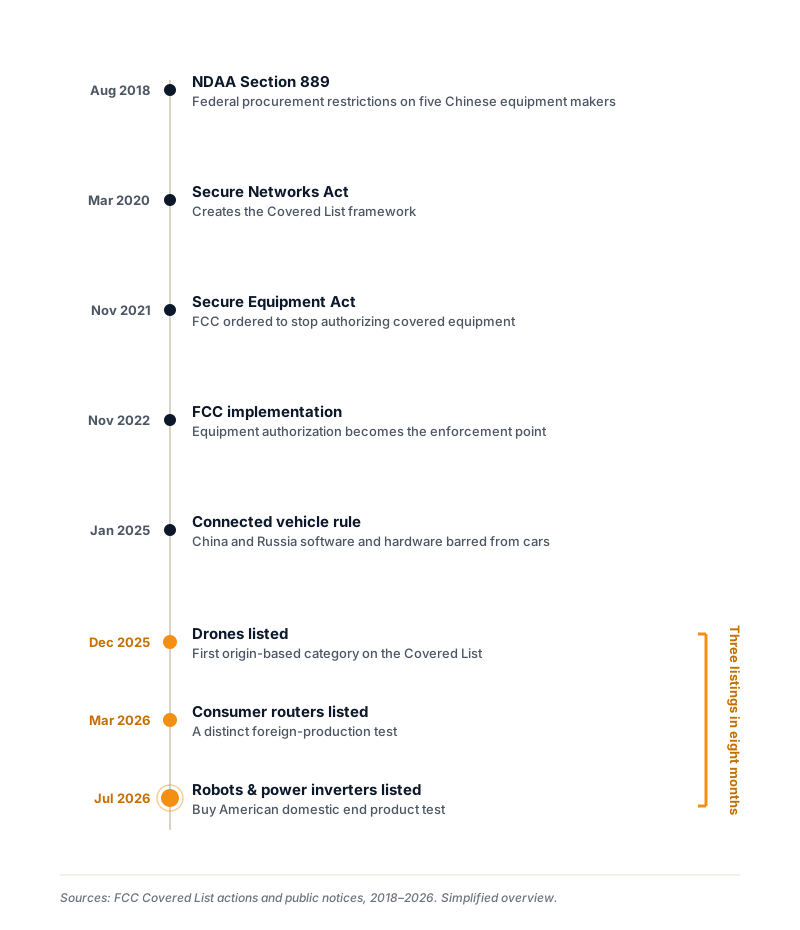
Named entities became whole categories. Federal procurement rules were joined by restrictions reaching the entire commercial market. The threshold is already scheduled to rise. Plan for more categories and higher bars, not a rollback.
Three paths, one deadline
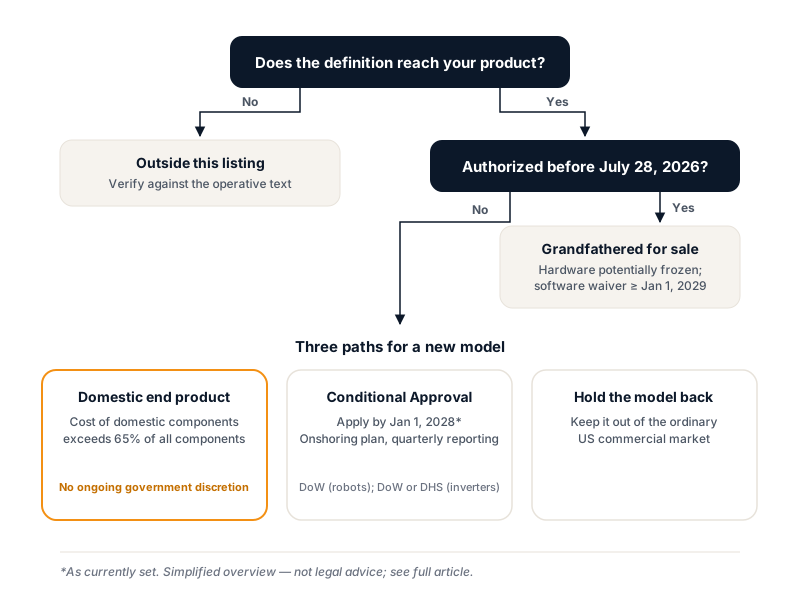
For a new model inside these definitions that needs FCC authorization for ordinary commercial sale:
- Qualify it as a domestic end product
- Obtain a Conditional Approval backed by a real onshoring plan
- Keep it out of the ordinary US commercial market
Path two runs through the Department of War (or, for inverters, DoW or DHS). Applicants disclose ownership, full bills of materials, and supply chains — then commit under officer certification to quantified US hiring, manufacturing space, and capital investment, reported quarterly. A knowing violation or material misrepresentation can end the approval and disqualify reapplication. For some companies, the disclosure alone decides it.
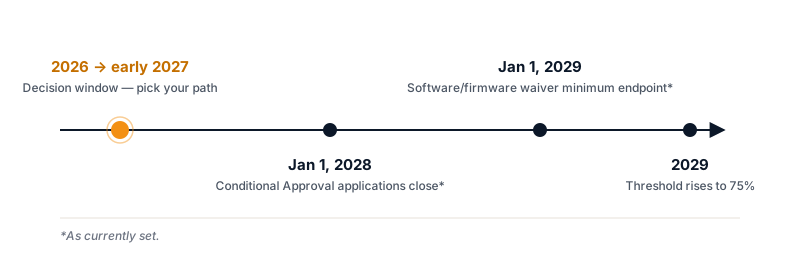
Work backward from the January 1, 2028 deadline. A credible application needs a manufacturing story behind it — which puts that decision in 2026 or early 2027.
What this may mean for manufacturing strategy
Everything above describes the regulation. What follows is a commercial response, not a legal conclusion.
The most useful structural fact: the test applies to the finished device, not to each part. These entries list no components. So the parts you cannot realistically move — cellular modems, Wi-Fi and GNSS modules, image sensors — can stay foreign, as long as their cost fits inside the foreign share a properly calculated analysis allows and the device separately satisfies the US-manufacture prong.
The biggest potential lever is substantive US manufacture of identifiable subassemblies. Under Buy American principles, a genuinely manufactured US component may qualify as domestic even when it contains foreign subcomponents — a populated circuit board, a battery pack, a wire harness. Where that holds, it moves cost out of the foreign column and may carry US manufacturing cost with it.
Three cautions. Component boundaries, what counts as manufacture, and which costs enter the calculation are fact-specific — screwdriver assembly may not qualify. The FCC has not addressed subcomponents, and has read this standard narrowly elsewhere. Validate the methodology with counsel before it enters a certification.
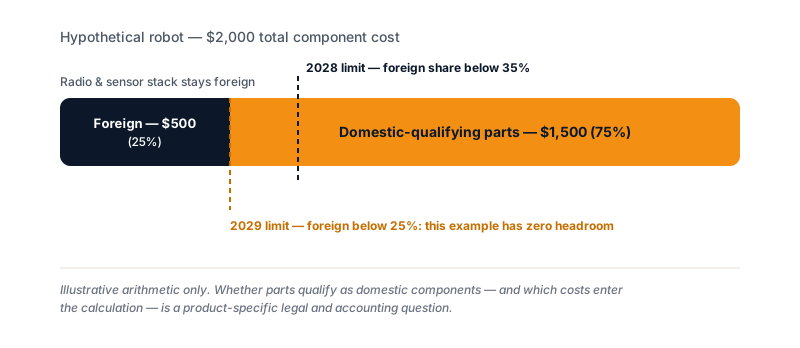
The arithmetic, for illustration only: a robot with $2,000 in component cost and a $500 radio-and-sensor stack that must stay foreign sits at 25% foreign. Whether the remaining parts legally qualify as domestic is a product-specific legal and accounting question.
Where does your foreign content sit?
Illustrative arithmetic only — not a compliance determination.
This tool checks one number in a multi-part test. It does not evaluate the US-manufacture prong, whether individual parts qualify as domestic components, or which costs enter the calculation — all of which are fact-specific. Validate any methodology with qualified counsel before it enters a certification.
One hard stop regardless of the math. A separate FCC order, scheduled to take effect 30 days after final-rule publication in the Federal Register, will bar authorization of a device incorporating certain logic-bearing hardware components — communications modules, chipsets, integrated circuits, other processing-capable subassemblies — produced by an entity subject to a producer- or provider-based Covered List determination, Huawei, ZTE, Hikvision, and Dahua among them, where the device would have been prohibited had that entity produced it directly. That reaches products built and branded by unrelated companies. Audit your BOM for entity components now.
(And clearing 65% does not create a Made in USA claim — the FTC's "all or virtually all" standard is separate and stricter.)
A qualified US contract manufacturer can reduce the capital and lead time required for path one, and may support the onshoring commitments in path two. It cannot guarantee domestic end product status or a Conditional Approval. What it can do is turn a plant-building problem into a sourcing and subassembly program — on a timeline no greenfield facility can match.
Where Lotus comes in
Lotus International Company has manufactured and supported complex products in Canton, Michigan since 1995. Our 300,000-square-foot Canton operation is certified to ISO 9001:2015 and ISO 14001:2015. We already provide the functions an offshore OEM needs on American soil: assembly, warehousing, depot repair, returns processing, and warranty intake.
The model is simple: your product, your brand, your customers. Lotus provides the American operations underneath them — assembly, subassembly manufacturing and testing in Michigan, US component sourcing, and component-level manufacturing, sourcing, origin, and cost records. You remain the applicant and certifying party. We provide the documentation needed for your analysis.
Canton offers direct access to Detroit Metro air freight and the Detroit–Windsor commercial corridor.
We work under NDA from the first conversation. Send us your product and bill of materials, and we will model how US assembly and sourcing could affect the domestic-content calculation — and what it may take to close the gap.
Lotus International Company · 6880 Commerce Blvd, Canton, MI · ISO 9001:2015 · ISO 14001:2015
Primary sources: FCC Public Notice DA 26-786 (July 28, 2026) and accompanying National Security Determinations; 48 CFR § 25.101(a)
This article provides general business information concerning recently issued FCC actions and does not constitute legal advice, a compliance determination, or a guarantee of FCC equipment authorization or Conditional Approval. Product classification, domestic content calculations, component origin determinations, permissible modifications, customs treatment, and labeling requirements are fact-specific and should be evaluated with qualified legal counsel and an accredited equipment authorization professional.