How to Set Up US Warranty Support Without Opening Your Own Service Center
Your first US orders can ship before you have a US service operation. Your first warranty claim may arrive just as quickly.

Your first US orders can ship before you have a US service operation. Your first warranty claim may arrive just as quickly.
Someone has to answer the customer, determine what went wrong, authorize the next step, and get a working product back to them. If your factory and technical team are overseas, even a straightforward failure can turn into a long exchange of emails, shipping quotes, and replacement requests.
An outsourced US warranty partner can handle those operations under your brand. You provide the product knowledge, warranty policy, and repair authorization. The partner supplies the people, workspace, systems, and logistics to carry them out.
You can begin with customer support, returns screening, and replacement fulfillment, then add local repair where the volume and economics justify it. Moving manufacturing is a separate decision.
Decide what happens to a claim before deciding where to repair it
Consider a customer who says a device will not turn on. That description could mean a failed component, an incorrect power supply, a setup problem, or damage in transit. Each requires a different response.
A service program needs an agreed sequence:
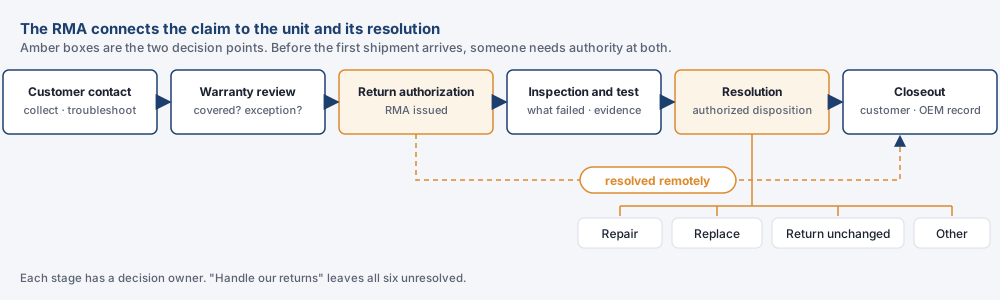
| Stage | Decision to make |
|---|---|
| Customer contact | What information will support collect, and what troubleshooting is appropriate? |
| Warranty review | Is the claim covered, and who can approve an exception? |
| Return authorization | Does the product need to come back, or can the issue be resolved remotely? |
| Inspection and testing | What failed, and what evidence supports that conclusion? |
| Resolution | Repair, replace, return unchanged, or use another approved disposition? |
| Closeout | What does the customer receive, and what is recorded for the OEM? |
Return merchandise authorization, or RMA, connects the customer’s claim to the physical unit and its eventual resolution.
A US returns address is only one part of this process. Before the first shipment arrives, someone needs authority to decide what happens next.
Choose the level of US support your product needs
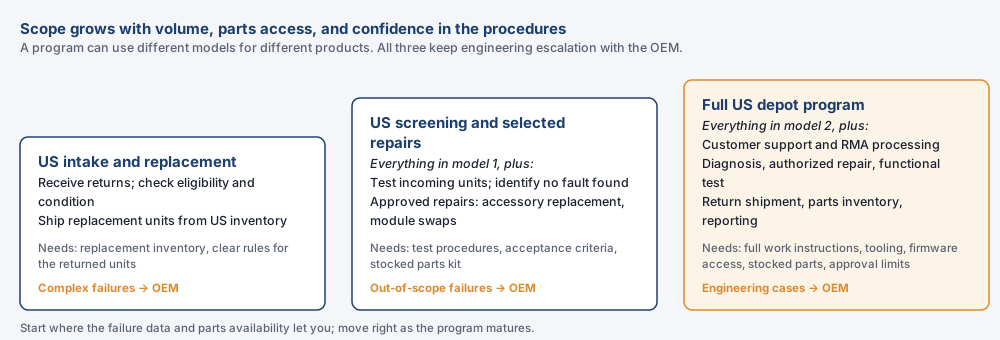
You do not need to transfer every repair procedure at launch. Three starting models are worth comparing.
US intake and replacement
The partner receives returns, checks eligibility and condition, and ships replacement units from US inventory. Complex failures remain with the OEM for further analysis.
This can suit a new program while local repair procedures are still being developed. It requires replacement inventory and clear rules for handling the returned units.
US screening and selected repairs
The partner tests incoming products, identifies units with no fault found, and performs approved repairs such as accessory replacement or module swaps. Failures outside that scope escalate to the OEM.
This creates a practical division of work: repeatable service tasks happen locally, while engineering retains unfamiliar or complex cases.
A full US depot program
The partner handles support, RMA processing, diagnosis, authorized repair, functional testing, and return shipment. Parts inventory and reporting support the operation.
The right model depends on failure patterns, product value, repair complexity, parts access, and customer expectations. A program can use different models for different products.
What your US warranty partner will need from you
A service partner can provide infrastructure, but it needs enough product information to make reliable decisions.
Prepare these materials before requesting a detailed implementation plan. Tick what you already have; the list stays on this page and goes nowhere.
Readiness checklist
0 of 9 readyIf you do not have historical returns data, say so. Build an initial forecast from expected sales and explicit assumptions, then revise it using actual claims.
A few sample units and representative failed products can help establish the work. They should be accompanied by instructions explaining what constitutes a passing result.
Keep ownership and approval rules explicit
Outsourcing works better when routine decisions do not require an international email chain.
For example, your policy might authorize a defined repair below an agreed spending limit. Repairs above that limit, repeat failures, and disputed claims could require OEM approval.
Document who controls:
- Warranty eligibility and exceptions.
- Repair spending and replacement authorization.
- Parts and replacement-unit inventory.
- Customer communications.
- Refurbishment, resale, parts recovery, and disposal.
- Product data, service records, and engineering escalation.
"Handle our returns" leaves too much unresolved. A technician should be able to determine the next authorized action from the case record and program instructions.
Budget for the whole program
There is no useful universal price for outsourced warranty support. A product that needs a short functional check creates different work from one requiring disassembly, diagnosis, repair, and extended testing.
Ask prospective partners to separate their quote into four parts:
Program setup: training, work instructions, fixtures, test equipment, systems integration, and pilot work.
Recurring charges: program management, storage, software access, or minimum monthly commitments.
Per-case work: customer support, receiving, inspection, diagnosis, repair, testing, and packing.
Materials and logistics: parts, replacement products, packaging, freight, and approved disposition.
Then compare the cost of resolving claims:
Cost per resolved claim = total program cost over a defined period ÷ claims resolved during that period
Use comparable scope and account for any growing backlog. A low repair price means little if it excludes diagnosis, testing, or the work needed to get the product back to the customer. The calculator below shows how much the headline repair price understates the real figure.
Cost per resolved claim
Enter a quote's four parts and your expected claims. Compare the per-case price to what a claim actually costs.
Ask how unsuccessful repair attempts, no-fault-found returns, repeat repairs, and units awaiting approval are billed.
Parts availability determines how quickly customers get answers
Local technicians cannot finish a repair if the required part is unavailable.
Choose initial US service stock using known failure patterns, replenishment lead times, part compatibility, and the consequences of a stockout. Decide whether parts belong to the OEM or the service partner, who authorizes replenishment, and who carries obsolete inventory.
Replacement products need the same planning. If you offer an advance exchange — shipping a replacement before receiving the failed unit — define eligibility, inventory allocation, and what happens when the original never arrives.
Measure parts-wait time separately from repair time. Otherwise, a program can report quick bench work while customers still wait weeks for resolution.
Start with a pilot that tests the difficult cases
Before transferring the entire program, run a limited set of products and representative claims through the proposed workflow.
Include more than straightforward repairs. Test a no-fault-found return, a missing serial number, an out-of-warranty claim, an unavailable part, and a repair requiring OEM approval.
Use the pilot to answer:
- Can both teams locate a unit and understand its status?
- Do technicians reach consistent test results?
- Can routine cases proceed without additional approval?
- Does the customer receive accurate updates?
- Do service records explain what failed and what was done?
- Does the invoice match the agreed pricing model?
Launch timing should follow readiness: trained staff, available parts, working tools, approved procedures, and usable records.
Measure customer resolution — and feed the findings back
Agree on a small set of measures before launch:
| Measure | Clock starts | Clock stops |
|---|---|---|
| Time to first response | Customer contact received | First substantive reply sent |
| Time from receipt to diagnosis | Unit received at depot | Failure confirmed and recorded |
| Total time to customer resolution | Customer contact received | Working product delivered or claim closed |
| Share of units awaiting parts or approval | Snapshot: units on hold ÷ units in process, by reason | |
| Repair success and repeat-return rates | Repaired units returning within a defined window ÷ units repaired | |
| No-fault-found rate | Units passing the agreed test ÷ units received | |
| Cost per resolved claim | Total program cost ÷ claims resolved, same period and scope | |
Define each measure, including when its clock starts and stops.
Failure reporting should also reach the people who can improve the product. A recurring connector failure, confusing setup step, or packaging problem deserves a different corrective action. Record enough detail to distinguish them.
Where Lotus fits
Lotus International Company provides US warranty intake, an in-house call center, RMA processing, depot repair, parts stocking, and reverse logistics from Canton, Michigan. It supports products manufactured elsewhere as well as products it builds.
Those services connect with warehousing, fulfillment, testing, and assembly. An OEM can evaluate a US service program first, then add other operations as its needs develop. Explore Lotus's depot repair and warranty services.
Planning US warranty support? Start with your product models, expected monthly returns, current service process, and top known failures. Those details give Lotus a basis for discussing what can be handled in Michigan, what your team needs to supply, and how to scope the program.